Debt payoff calculator for snowball and avalanche
Enter each debt's balance, APR and minimum payment, plus any extra you can pay each month. The debt payoff calculator shows when you could be debt-free with the snowball and avalanche methods. Print the payoff plan and color in your progress.
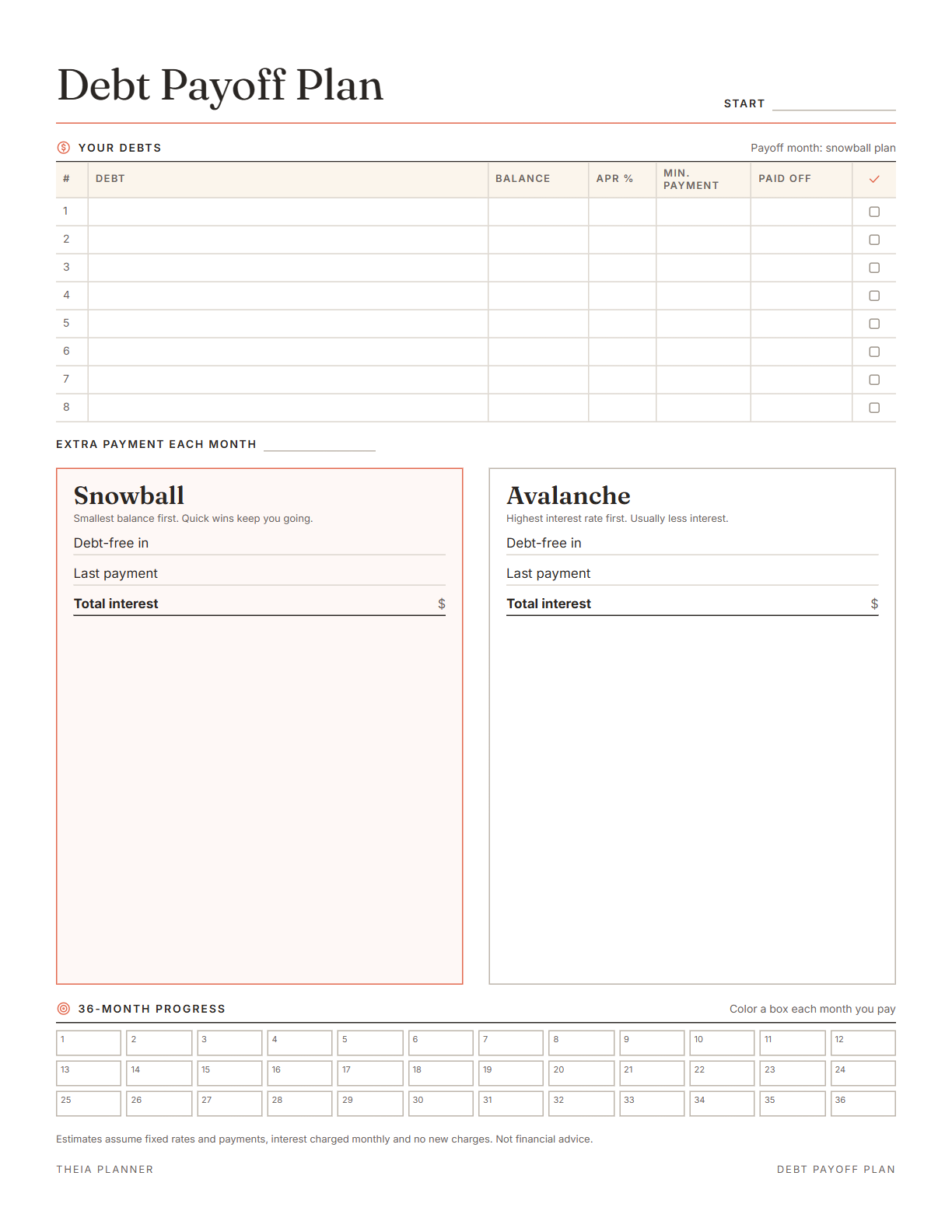
Free debt snowball calculator with a printable plan
Pick your settings, type on the lines and tick the boxes, then print it or save it as a PDF. It is free, with no sign-up and no email.
Estimates assume fixed rates and payments, interest charged monthly and no new charges. Not financial advice.
What the debt payoff calculator shows
How to use the debt payoff estimator
- List your debtsType the balance, APR and minimum payment from each statement. Add an extra monthly payment if you can afford one.
- Compare the two methodsRead the months to debt-free and the total interest for snowball and avalanche, then pick the plan you will follow.
- Print and trackPrint the plan or save a PDF. Tick each debt's box when it is gone, and color one grid square every month.
The free online version, in action
What is the snowball method, and how does the avalanche differ?
Both methods pay the minimum on every debt and send any extra money to one target debt. They differ only in which debt gets the extra first. Here is how each one works and what to weigh when you choose.
You list debts from the smallest balance to the largest and put the extra on the top one. When it is paid off, its payment joins the extra for the next debt, so the amount grows with each payoff. A debt snowball calculator shows how soon that first payoff could come.
A small debt clears early, which many people find motivating. A high-rate debt may wait longer for its turn, which can add interest over the whole plan.
Paying the most expensive debt first usually means less interest over time. A debt avalanche calculator shows how much interest that could save. The first payoff may take longer if your costliest debt is also a large one.
The gap between the two methods can be small or large, depending on your balances and rates. Look at both the total interest and the months to debt-free. If the results are close, pick the method you are more likely to stick with.
It assumes fixed rates and payments, interest charged monthly and no new charges. New spending on a card pushes the finish date back. Check your real balances against the plan every few months.
This page is general information and not financial advice. Your lender or a nonprofit credit counselor can talk through your options.
Reminders in your Google Calendar
Connect Google Calendar once, and these items are added to a separate “Theia Planner” calendar. Items with a time get a reminder 30 minutes before.
How calendar sync works- Card and loan due dates you add as bills
- Those bills repeating every month
- A repeating task for your extra payment day
Who the debt payoff calculator is for
See which card to pay first and roughly when the last balance could be cleared.
Add each loan with its own rate to see how an extra payment changes the timeline.
Run the numbers side by side, agree on a method and put the printed plan where you both see it.
Try a few extra payment amounts to see how much sooner the debt could be gone.
Debt payoff plan on paper or in an app?
Each option works. The table below shows what each one does for you.
| Feature | Theia Planner | Free printable | Spreadsheet |
|---|---|---|---|
| Free to start | |||
| Set up for you in about a minute | |||
| Reminders on your phone | |||
| Dates and totals worked out for you | |||
| Works on phone and computer | |||
| Shared with family, with roles | |||
| A paper copy for the fridge |
Debt payoff calculator questions
Is the debt payoff calculator free?
Yes. Use it, print the plan and download a blank PDF without a sign-up or an email address.
Debt avalanche vs snowball: which costs less?
The avalanche usually costs less interest, because the highest rate is paid first. The snowball often clears a first debt sooner, and the calculator shows both.
What is a snowball method for paying off debt?
It is a payoff order that pays the minimum on every debt and puts any extra money on the smallest balance. When that debt is gone, its payment moves to the next smallest balance. The payment grows with each debt you clear.
Can I use it as a debt payoff estimator for one debt?
Yes. Enter a single debt with its balance, APR and minimum payment. Add an extra amount to see how many months it saves.
Is this a payoff calculator credit card holders can use?
Yes. Enter each card's balance, APR and minimum payment from the statement. It works for car loans, student loans and other debts too.
What happens if my minimum payment is too low?
The calculator warns you when a minimum payment does not cover the monthly interest. At that payment, the balance would not go down.
Is the debt payoff calculator exact or financial advice?
No. It is a planning tool that gives estimates only, and your real finish date may differ. For advice on your own situation, speak with a nonprofit credit counselor or a financial adviser.
How is it different from the debt payoff tracker?
The calculator compares two methods and prints a plan. The debt payoff tracker is a free online board where you log payments as you make them.
More free planners and trackers

Track your debts free online
It is free to start, and the setup takes about a minute.
Start free